GulfGate — Immigration UX Platform
Lead UX Designer · Legal Tech · Trust Architecture · Migration Platform
8
Users Interviewed
3
Target Markets
5
Core Pages Designed
3
Key Task Flows
Overview
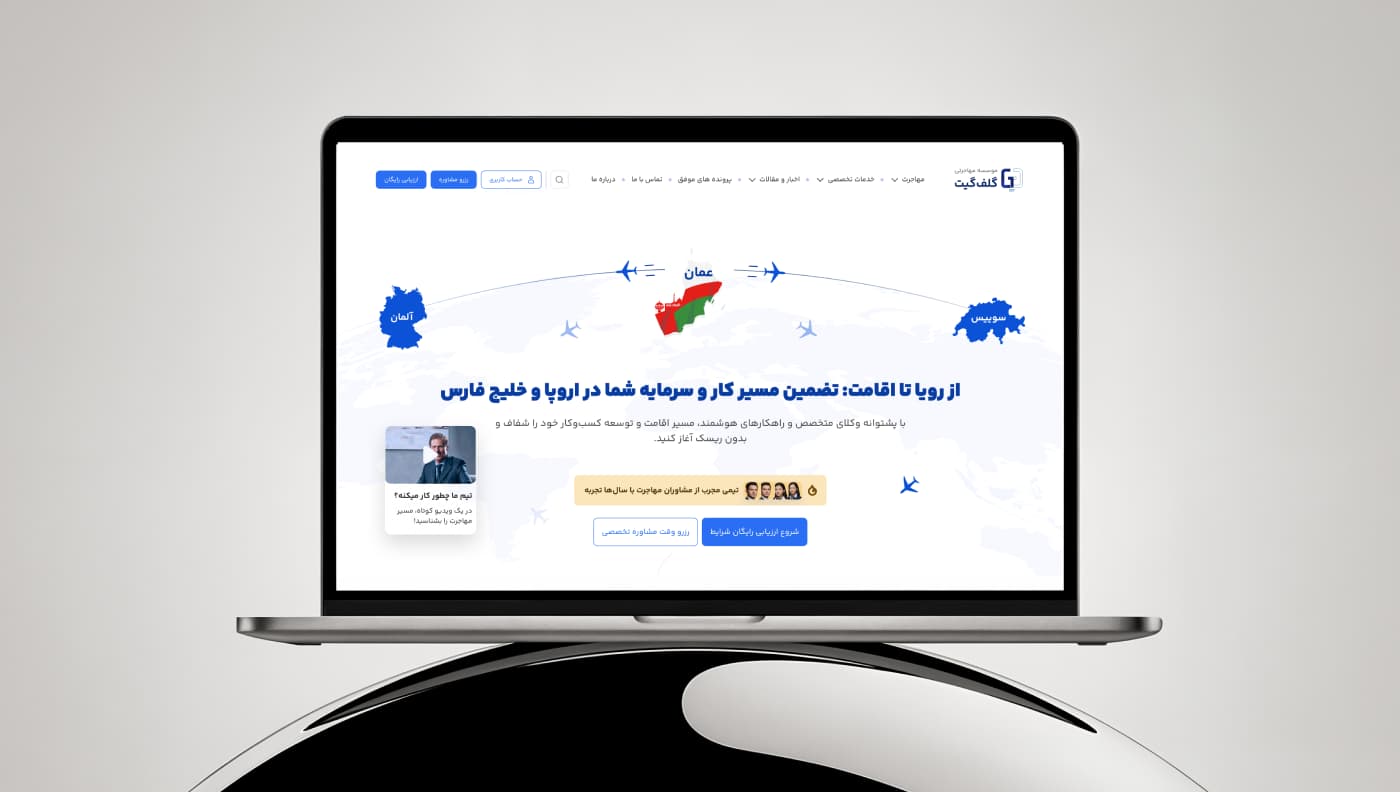
Digital platform transforming the immigration process into a legally-backed system for Switzerland, Germany, and Oman. Research question: how can UX architecture convert immigration uncertainty into measurable user trust?
Challenge
Over 50% of target users found existing online sources contradictory and untrustworthy. Traditional immigration consulting lacked cost transparency, legal credibility signals, and unified case-tracking — making high-stakes decisions stressful and abandonment-prone. Users felt treated as sales targets, not people with legitimate fears.
Impact & Results
Delivered end-to-end UX system covering 5 core pages and 3 critical conversion flows. Defined two market-differentiating Value Propositions absent in all analyzed competitors: immigration cost calculator (financial transparency) and embassy interview simulator (confidence building). Atomic Design system established for scalable development. 3-step assessment flow and frictionless booking reduce decision barriers for high-intent users.
Approach & Methodology
User-Centered Design: (1) Stakeholder interviews aligning business revenue goals with user needs; (2) JTBD analysis + 8-user depth interviews via Google Meet; (3) Quantitative questionnaire confirming >50% source distrust at scale; (4) Competitive analysis mapping self-service tool gaps; (5) Affinity diagram → 4 core themes; (6) 3 personas — Barbad (investor, fears hidden costs), Sara (needs dedicated support), Nastaran (journey mapping) + Empathy Maps + User Journey Maps; (7) Storyboard, Task Flows, Site Map; (8) Low-fidelity wireframes → Yekan Bakh Style Guide → Atomic Design system → High-fidelity UI.
Key Takeaways
Trust in immigration services is an information architecture problem — users need cost transparency, eligibility clarity, and step-by-step guidance before they engage with any provider. Self-service tools (cost calculator, interview simulator) are not features: they are trust infrastructure. Designing for high-stakes decisions requires emotional precision: every CTA placement must map to a specific user fear.
Next Project